
The Audit Readiness Mandate: Overcoming Operational Blindness and Hiring The Qualified Consultant(s)


Achieving and maintaining constant audit readiness is a critical operational mandate for life sciences, manufacturing, and highly regulated industries—especially given the rise of unannounced FDA inspections. For two consecutive years, the State of Validation Report (State of Validation 2026) has ranked audit readiness as the #1 industry concern.
Internal teams are frequently consumed by daily production demands or lose their objectivity over time—a phenomenon known as "operational blindness."
To bridge this gap, companies routinely bring in external consultants. While the FDA explicitly highlights the value of consultants and outlines baseline requirements in 21 CFR § 211.34, hiring based purely on surface-level credentials can be a major liability. Numerous firms have been formally cited by the FDA for utilizing unqualified consultants after choosing them based solely on a shining CV and costs.
§ 211.34 Consultants.
Consultants advising on the manufacture, processing, packing, or holding of drug products shall have sufficient education, training, and experience, or any combination thereof, to advise on the subject for which they are retained. Records shall be maintained stating the name, address, and qualifications of any consultants and the type of service they provide.
Here are FDA-483 and Warning Letter regarding "qualified consultant"

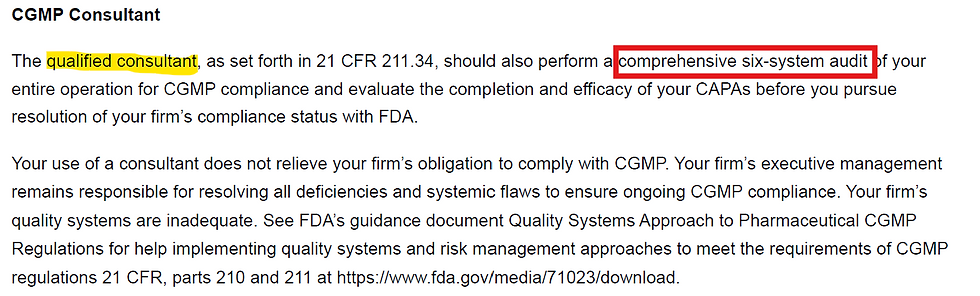
Below is an advanced breakdown of how leading companies identify a truly "qualified" consultant and exactly what these experts contribute to the audit readiness lifecycle.
Part A: Defining a "Qualified" Consultant
Under regulatory frameworks like CGMP, a consultant is not just an advisor; they are an extension of your quality unit. True qualification extends far beyond a prestigious resume. Companies should assess consultants using five primary benchmarks:
1. Regulatory and Technical Alignment (21 CFR § 211.34)
The FDA dictates that consultants must possess a combination of education, training, and experience specific to the exact subject for which they are retained.
The Technical Match: A consultant qualified to audit a solid-oral dosage facility may not be qualified to audit a sterile, aseptic biologics cleanroom subject to complex environmental monitoring or regulations like EU Annex 1.
The Laboratory Matrix: Academic and practical alignment is vital; a consultant lacking formal chemistry and microbiology backgrounds will fundamentally struggle to effectively audit an analytical or microbial laboratory.
2. Holistic Critical Thinking (Connecting the Dots)
Even consultants with flawless technical training, education, and experience can fail to uncover systemic vulnerabilities if their knowledge is siloed. A truly qualified consultant must possess advanced critical thinking skills to "connect the dots" across the organization. In the biopharmaceutical world, a well-rounded consultant looks beyond individual data points to see how issues intertwine across all six quality systems, ultimately mapping those failures to the broader clinical picture of the products under scrutiny. Note: there are very few qualified consultants that can audit six quality systems effectively and efficiently. You may need to hire several consultants (i.e. quality, chemist, microbiologist, production, etc.) if you cannot find the one that has that comprehensive knowledge.
3. "In the Trenches" Expertise vs. Actual Auditing Skill
Top-tier consultants are often former regulatory investigators (e.g., ex-FDA) or veteran Quality Assurance (QA) directors who intimately understand modern enforcement trends, data integrity, and ALCOA+ principles. However, organizations must verify active auditing capability over mere titles.
⚠️ The Expertise Trap: It is a known industry reality that some ex-FDA investigators or senior corporate QA executives struggle to deliver and therefore not retained again because they lack the specific, investigative auditing skills required to drill down and uncover deep, systemic non-compliances. Credentials must be backed by a proven track record of diagnostic execution.
This capability gap explains why some firms appear to have zero or low compliance issues for years—until a comprehensive, highly skilled FDA investigator arrives and uncovers hidden, long-standing systemic failures.
4. Complete Objectivity
A qualified consultant must have no internal political ties, personal history with the site’s processes, or fear of corporate hierarchy. This absolute independence allows them to deliver direct, unvarnished assessments of compliance vulnerabilities before an official inspector uncovers them.
5. Comprehensive Record-Keeping
Regulations require companies to maintain official records of a consultant's name, address, core qualifications, and the specific services provided. A truly qualified professional will come prepared with a comprehensive, easily auditable CV and a transparent billing/reporting structure.
Part B: What Consultants Contribute to the Audit Readiness Lifecycle
A qualified consultant does not simply point out superficial problems; they systematically close compliance gaps and fortify the facility's quality culture.
[Gap Analysis] ➔ [Clinical/Product Assessment] ➔ [Mock Audits & 483s] ➔ [Data Research] ➔ [QMS & Front/Back Room Training]
Their contributions typically span eight key areas:
1. Initial Assessment & Gap Analysis
Before an audit occurs, a consultant performs a thorough baseline evaluation of the site. They review facility design, material/personnel flow, manufacturing processes, laboratory testing, equipment validation status (IQ/OQ/PQ), and historical data to map out exactly where existing systems deviate from current regulatory expectations.
2. Clinical and Therapeutic Impact Evaluation
A well-rounded consultant evaluates the clinical impact of the drug products and their specific formulations. They seamlessly bridge the gap between technical operations and patient safety by linking CGMP issues, out-of-specification (OOS) results, and testing anomalies directly back to real-world consumer complaints and adverse events. This holistic view focuses entirely on validating the manufacturer’s ability to build unwavering quality and confidence into every single dose produced.
3. Rigorous Mock Inspections
Consultants execute stressful, "blind" simulated audits that mimic the exact tactics of regulatory inspectors. They test the facility's ability to retrieve documents under tight time constraints, evaluate operator behavior on the manufacturing floor/testing lab, and stress-test data trails within computerized systems.
4. Drafting Valid Mock FDA-483s and EIRs
Less experienced consultants often write up a mountain of trivial, indiscriminate observations just to prove they found something. A premier consultant writes a mock FDA-483 and EIR focused strictly on valid, impactful observations that align with historical FDA-483 trends, Warning Letters, and explicit statutory regulations. They prioritize the critical, underlying systemic failures that only a few elite auditors are skilled enough to catch.
5. Advanced, Data-Backed Analysis
While many consultants mistakenly lean on public, generic AI tools for answers, a top-tier consultant mirrors the targeted, sophisticated data approach used by the FDA (such as their internal ELSA AI tool). They utilize highly reliable, relevant, and resourceful intelligence—cross-referencing historical FDA-483s, Warning Letters, Complete Response Letters (CRLs), USP monographs, ICH guidelines, FDA guidance documents, EU Annexes, and PDA technical reports. This ensures every citation is rooted in rigorous science and linked directly to an actual quality risk.
6. QMS, SOP, and CAPA Remediation
If an internal process is broken or poorly documented, the consultant aids in rewriting Standard Operating Procedures (SOPs) and restructuring the Quality Management System (QMS). They ensure your systems are robust enough to handle deviations, OOS results, Corrective and Preventive Actions (CAPAs), and crucially, CAPA Effectiveness checks in a manner that will withstand intense regulatory scrutiny.
7. Personnel Training & "Front Room / Back Room" Strategy
An audit's success relies heavily on communication. Consultants train subject matter experts (SMEs) on how to answer an inspector's questions directly, honestly, and without volunteering extraneous information. They also organize the logistical "back room" (document review arena) to ensure frictionless information flow to the "front room" where the inspector sits.
8. Crisis Management & Post-483 Response
If a company has already received an adverse finding, such as an extensive FDA Form 483 or a Warning Letter, a consultant acts as rapid triage. They perform root-cause analyses, draft highly technical and legally sound rebuttals to the Agency, and build the immediate remediation roadmap required to restore compliance.
🛡️ The Compliance Guardrail: While hiring a highly qualified consultant dramatically improves your chances of a successful audit, regulatory bodies are explicit: the use of a consultant does not relieve the firm's executive management of its ultimate obligation to comply with CGMP. The consultant provides the blueprint and the tools, but ownership of the quality system must remain entirely with the company.
Is your company or CDMO audit ready at all times?


Comments